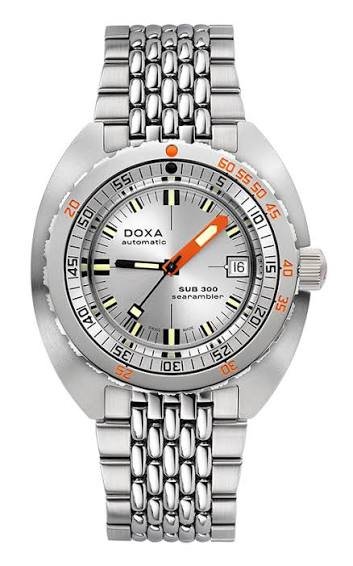
A mechanical watch measures time without a battery, electronic circuit or computer chip. It operates through a carefully organized system of springs, wheels, gears and levers.
When the watch is wound, energy is stored inside a coiled mainspring. That energy travels through the movement, where it is divided into precisely controlled portions. The controlled energy eventually moves the hour, minute and seconds hands around the dial.
Although a mechanical movement may contain hundreds of individual components, its basic operation can be understood through five essential systems:
- The mainspring stores the energy.
- The gear train transfers the energy.
- The escapement releases the energy in controlled steps.
- The balance wheel regulates the timing.
- The motion works move the watch hands.
The Movement: The Engine Inside the Watch
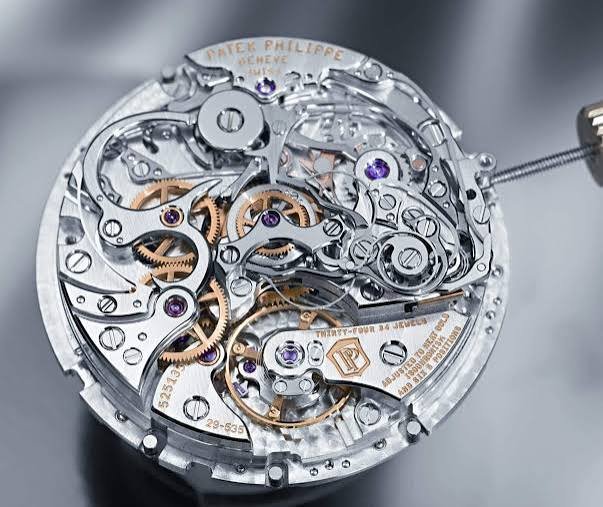
The complete mechanism inside a watch is called its movement, or sometimes its calibre.
The movement includes the energy source, gears, regulating system, winding mechanism and the components that operate the hands. Additional mechanisms can be added to provide complications such as a date display, chronograph, power-reserve indicator, annual calendar or moon phase.
The movement is supported by a mainplate and a series of bridges. These metal structures hold the gears and other components in their correct positions.
A mechanical watch movement must perform two jobs continuously:
- It must provide enough power to keep the watch running.
- It must control that power accurately enough to measure time.
Without regulation, the mainspring would release all its stored energy very quickly and the watch hands would spin uncontrollably. The watch’s escapement and balance wheel prevent this from happening.
Step 1: The Mainspring Stores the Energy
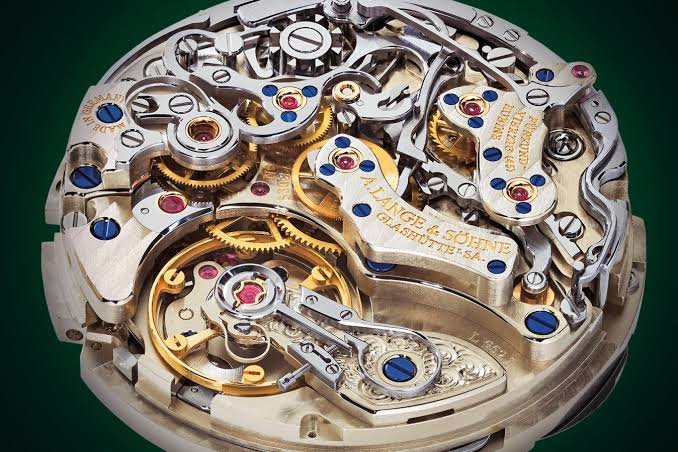
The mainspring is a long, thin strip of metal coiled inside a circular container called the barrel.
Turning the watch’s crown winds the mainspring more tightly. As the spring tightens, it stores mechanical energy. The gradual release of this energy powers the movement.
The barrel has gear teeth around its outer edge. As the mainspring slowly unwinds, it turns the barrel and transfers energy into the watch’s gear train.
The amount of time that a fully wound watch can operate is called its power reserve. Many mechanical watches provide approximately 38 to 72 hours of power reserve, although some movements can operate for several days.
A mechanical watch should be wound smoothly and carefully. When a manually wound watch reaches resistance, the wearer should stop turning the crown rather than applying unnecessary force.
Step 2: The Gear Train Transfers the Energy
The gear train is a sequence of precisely shaped wheels and pinions.
Energy moves from the mainspring barrel through these gears toward the escapement. The different sizes and numbers of teeth control the speed at which each wheel turns.
A traditional gear train commonly includes:
- The center wheel
- The third wheel
- The fourth wheel
- The escape wheel
The fourth wheel often completes one rotation every minute. In many movements, the seconds hand is connected either directly or indirectly to this wheel.
The gears rotate on extremely small pivots. Friction at these points must be reduced because excessive friction would waste energy and affect the watch’s accuracy.
Why Mechanical Watches Use Jewels
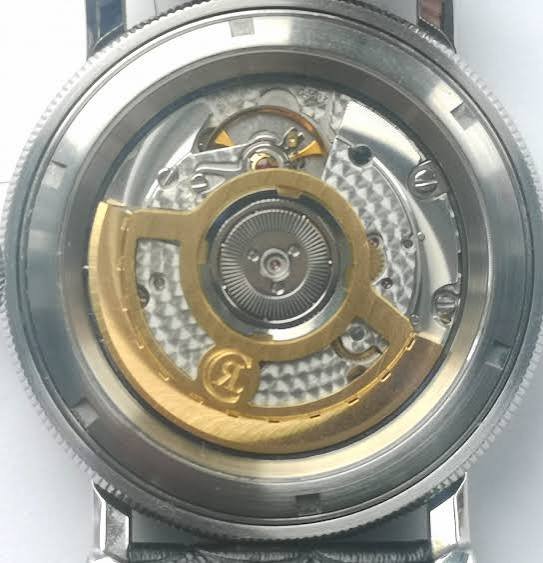
Many mechanical movements contain synthetic ruby bearings known as jewels.
These jewels are positioned at important friction points, especially where rotating wheel pivots contact the movement’s plates and bridges. Synthetic ruby is hard, smooth and resistant to wear.
The jewel count does not automatically determine the quality of a watch. A straightforward mechanical movement may operate efficiently with approximately 17 jewels. More complicated movements may require additional jewels because they contain more moving components.
The purpose of a jewel is functional: it helps reduce friction and wear while supporting the movement’s small rotating parts.
Step 3: The Escapement Controls the Energy
The escapement is one of the most important systems in a mechanical watch.
It prevents the gear train from rotating freely and releases its energy in small, controlled portions. A common Swiss lever escapement includes:
- The escape wheel
- The pallet fork
- Pallet jewels
- The impulse jewel connected to the balance wheel
As the pallet fork moves back and forth, its jewels alternately lock and release the teeth of the escape wheel. Each release allows the gear train to advance by a controlled amount.
This locking and releasing action produces the familiar ticking sound of a mechanical watch.
The escapement also gives a small impulse to the balance wheel during each cycle. This replaces energy lost through friction and helps keep the balance wheel oscillating.
Step 4: The Balance Wheel Regulates Time
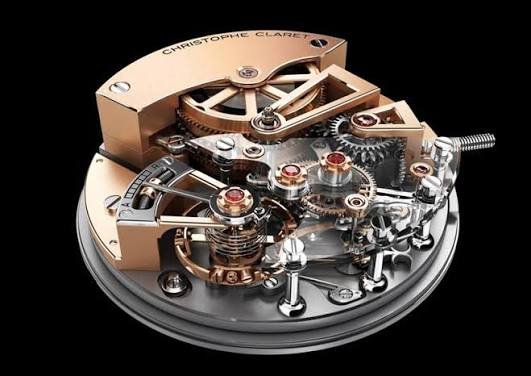
The balance wheel is the time-regulating organ of a mechanical wristwatch.
It rotates back and forth at a steady rate. Attached to it is a very fine spiral spring called the balance spring or hairspring.
The balance wheel and hairspring work together in a way similar to the pendulum of a traditional clock. The balance spring pulls the balance wheel back toward its resting position after each movement.
A movement’s frequency is often expressed in vibrations per hour, or vph, and sometimes in hertz.
Common mechanical-watch frequencies include:
- 18,000 vibrations per hour
- 21,600 vibrations per hour
- 28,800 vibrations per hour
- 36,000 vibrations per hour
A movement operating at 28,800 vibrations per hour completes eight beats each second, equivalent to a frequency of 4 hertz.
The repeated oscillation of the balance wheel controls how frequently the escapement releases the gear train. This is how the watch divides continuous spring energy into measurable portions of time.
Step 5: The Motion Works Move the Hands
The gear train provides the regulated rotation needed to display the time. Another set of gears called the motion works converts that rotation into the movement of the hands.
The minute hand completes one rotation every hour. The hour hand completes one rotation every 12 hours. The seconds hand normally completes one rotation every minute.
The crown and setting mechanism allow the wearer to disconnect or reposition part of the motion works when setting the time.
Some watches include a hacking-seconds feature. Pulling out the crown stops the seconds hand, allowing the watch to be synchronized more precisely with a reference time.
Manual-Winding Mechanical Watches
In a manually wound watch, the wearer turns the crown to tighten the mainspring.
The crown is connected to the winding stem and a series of gears. Turning it transfers energy to the mainspring barrel.
A manually wound watch may need to be wound every day or every few days, depending on its power reserve.
Many collectors enjoy this daily interaction. Winding the watch becomes a small ritual and provides a direct connection between the owner and the movement.
Automatic Mechanical Watches
An automatic watch is still a mechanical watch, but it includes a self-winding system.
A semicircular weight called a rotor moves as the wearer’s wrist changes position. The rotor’s movement operates a series of gears that wind the mainspring.
Depending on the movement’s design, the rotor may wind the watch in one direction or in both directions.
An automatic mainspring uses a slipping attachment that helps prevent damaging overwinding. When the mainspring reaches its designed tension, the outer end can slip inside the barrel rather than continuing to tighten indefinitely.
If an automatic watch is not worn for longer than its power reserve, it will stop. It can normally be restarted by winding the crown, gently moving the watch or doing both according to the manufacturer’s instructions.
Why the Seconds Hand Appears to Sweep
A quartz watch commonly moves its seconds hand once per second. A mechanical watch usually advances the hand several times each second.
These rapid small movements create the appearance of a sweeping seconds hand.
The smoothness depends partly on the movement’s frequency. A watch operating at a higher frequency generally advances its seconds hand in more increments each second.
However, a higher frequency does not automatically mean that one movement is superior to another. Movement design, adjustment, materials, lubrication and maintenance all influence performance.
What Affects Mechanical-Watch Accuracy?
A mechanical movement can be affected by:
- Position
- Temperature
- Magnetism
- Shock
- Lubricant condition
- Component wear
- Balance-wheel adjustment
- Mainspring torque
A watch may run at slightly different rates when placed dial-up, crown-down or in another position. This occurs because gravity affects the balance and escapement differently as the watch changes orientation.
Magnetism can cause components—particularly the hairspring—to behave incorrectly. A magnetized watch may suddenly run much faster or display irregular performance.
Modern watchmakers use antimagnetic materials, improved hairsprings and shock-protection systems to reduce these problems.
Why Mechanical Watches Require Servicing
Mechanical movements contain components that operate continuously under small but persistent forces.
Lubricants reduce friction between moving parts. Over time, these lubricants can deteriorate, migrate or dry. Dust, moisture and worn components can also affect performance.
During a complete service, a qualified watchmaker generally:
- Removes the movement from the case.
- Disassembles the movement.
- Cleans the components.
- Inspects them for damage or wear.
- Replaces necessary parts.
- Reassembles and lubricates the movement.
- Regulates and tests the watch.
- Checks the case, crown, gaskets and water resistance when applicable.
Service intervals vary according to the movement, manufacturer, condition and use of the watch. Owners should follow the manufacturer’s recommendation and seek professional inspection if a watch begins performing abnormally.
Mechanical Watches Versus Quartz Watches
A quartz watch uses electrical energy and a vibrating quartz crystal to regulate time. Quartz movements are generally more accurate, affordable and resistant to everyday disturbances than traditional mechanical movements.
A mechanical watch is valued for different reasons.
It represents miniature engineering, skilled assembly and centuries of horological development. The movement transforms energy stored in a metal spring into a controlled and visible measurement of time.
Neither system is universally better. A quartz watch may be the practical choice when maximum accuracy and low maintenance are priorities. A mechanical watch may be preferred for its craftsmanship, history, repairability and emotional character.
A Small Machine That Never Rests
A mechanical watch is a remarkable chain of energy and motion.
The mainspring stores the energy. The gear train transfers it. The escapement divides it into controlled portions. The balance wheel establishes the rhythm. The motion works translate that rhythm into the movement of the hands.
Every tick represents the coordinated action of dozens—or sometimes hundreds—of precisely manufactured components.
That continuing interaction is what makes a mechanical watch more than an object that displays the time. It is a miniature machine designed to operate day and night, carried on the wrist and powered entirely by mechanical energy.