Avant-garde time machines since 1997
Urwerk
URWERK was founded in 1997 by master watchmaker Felix Baumgartner and artist-designer Martin Frei. The independent Swiss manufacture reinterprets historic wandering-hour displays through orbiting satellites, retrograde minutes, sculptural cases and experimental control systems. From the early UR-101 and UR-102 to the UR-103, EMC, UR-100 and UR-150, its work helped define contemporary avant-garde watchmaking.
Abbady photographic archive
Urwerk photographs




Origins and period
Geneva and Zurich, Switzerland
Founded in 1997; independent manufacture active today
Urwerk in watchmaking
URWERK was founded in 1997 by master watchmaker Felix Baumgartner and artist-designer Martin Frei. The independent Swiss manufacture reinterprets historic wandering-hour displays through orbiting satellites, retrograde minutes, sculptural cases and experimental control systems. From the early UR-101 and UR-102 to the UR-103, EMC, UR-100 and UR-150, its work helped define contemporary avant-garde watchmaking.
Landmark dates
1997 — URWERK launched the UR-101 and UR-102 at Baselworld
2003 — The UR-103.01 introduced forward-facing three-dimensional hour satellites
2005 — URWERK and Harry Winston unveiled the Opus 5
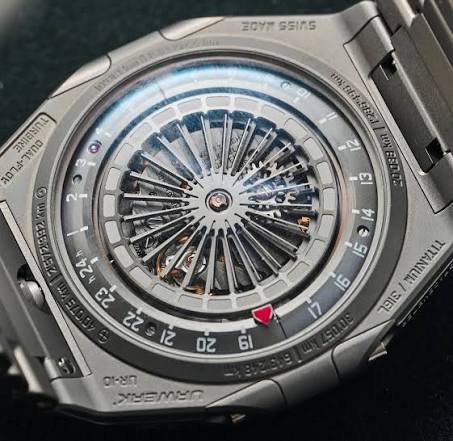
2008 — The UR-202 paired the revolving satellite display with turbine-regulated automatic winding
2011 — The UR-110 and the monumental UR-1001 Zeit Device expanded the satellite concept
2013 — The EMC gave its wearer an electronic means to monitor and mechanically adjust rate
2017 — The transformable UR-T8 marked URWERK’s twentieth anniversary
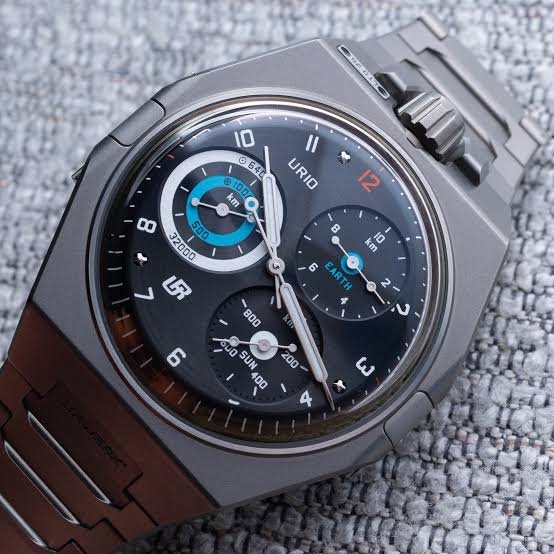
2019 — The UR-100 SpaceTime combined satellite timekeeping with astronomical indications
2020 — The manually wound UR-220 revived the oil-change service indicator
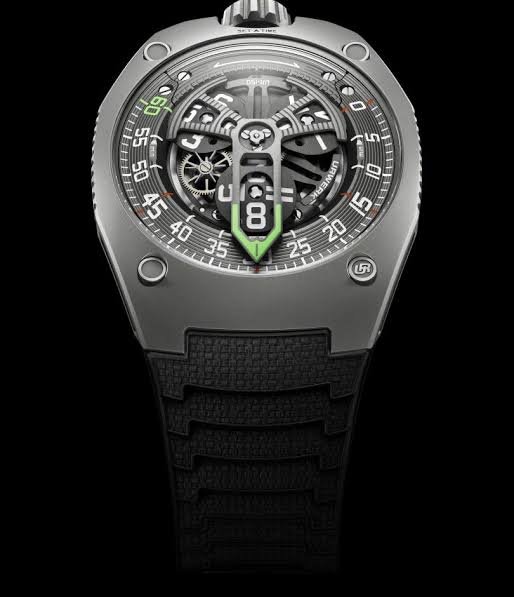
2024 — The UR-150 Scorpion introduced a new satellite display with a dramatic retrograde minute hand
Known for
Satellite wandering-hour displays; UR-101 and UR-102; UR-103; Opus 5; UR-202 and turbine-regulated winding; UR-110; UR-1001 Zeit Device; EMC chronometry system; AMC atomic master-slave concept; UR-100 SpaceTime; UR-220; UR-150 Scorpion; and highly limited independent production.
Movements and innovation
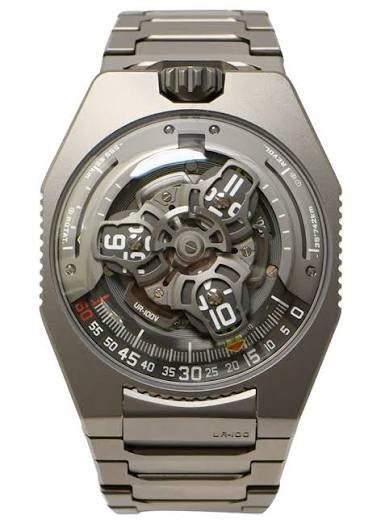
URWERK builds mechanical calibres around unconventional indications rather than conventional dial layouts. Its revolving satellite systems use rotating hour modules and planetary gearing, while turbine governors regulate automatic winding in models such as the UR-202 and UR-100V. The EMC combines a mechanical movement with an optical sensor and electronic reference oscillator so the owner can measure rate and make a mechanical adjustment. Other projects include retrograde minutes, service and winding-efficiency indicators, and the AMC atomic master-slave system.
Identification checklist
Confirm the engraved reference, individual number, case material, calibre marking, satellite layout and crown position. Compare the case architecture, hour modules, minute track, turbine or control-board details and luminous colors with official technical sheets. Many editions differ only in coatings, metals, straps or small display details, so front photographs alone may not establish the exact variation. Verify provenance, service records, accessories and authorized-dealer documentation.
Preservation guidance
Use an URWERK-authorized or appropriately qualified haute-horlogerie specialist. Do not disassemble satellite modules, turbine systems or EMC electronics outside expert service. Avoid polishing angular case surfaces or refinishing coatings, and do not assume water resistance after age or service. Protect sapphire crystals and articulated displays from impacts, keep magnets and strong electromagnetic fields away, and retain the presentation box, tools, certificates, service papers and replaced original components.
Historical development
Watchmakers Felix and Thomas Baumgartner and designer Martin Frei founded Urwerk to reinterpret historic wandering-hour displays through futuristic mechanics. Rotating satellite indications, sculptural cases, and experimental control systems made it a defining independent watchmaking house.