The historic Russian factory behind Pobeda and Raketa watches
Petrodvorets
The Petrodvorets Watch Factory traces its institutional history to the Imperial Peterhof Factory, founded by Peter the Great in 1721 to cut and polish hardstone for palaces, monuments and diplomatic gifts. Its craftsmen developed precision skills in stone and jewel work that later supported industrial production. The site suffered severe destruction during the Second World War and was rebuilt after the Siege of Leningrad. In the mid-1940s it entered watch production, initially making Pobeda watches and components as the Soviet Union expanded domestic horology. In 1961 the factory introduced the Raketa name—Russian for “rocket”—in the era of Yuri Gagarin’s spaceflight. Petrodvorets became a major vertically integrated Soviet manufacturer, producing movements and millions of civilian, military, professional and commemorative watches. After a difficult post-Soviet contraction, the factory and Raketa brand were revived with renewed emphasis on in-house mechanical production and historic Russian designs.
Abbady photographic archive
Petrodvorets photographs
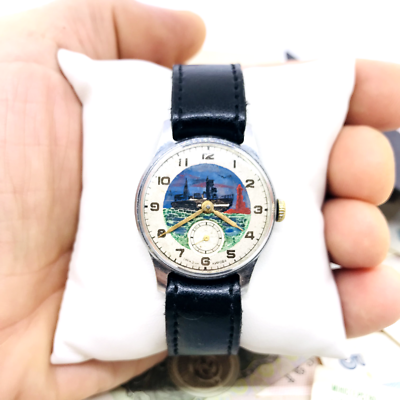
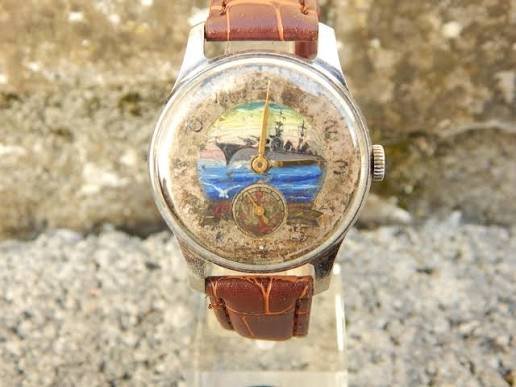
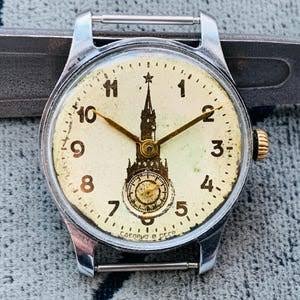
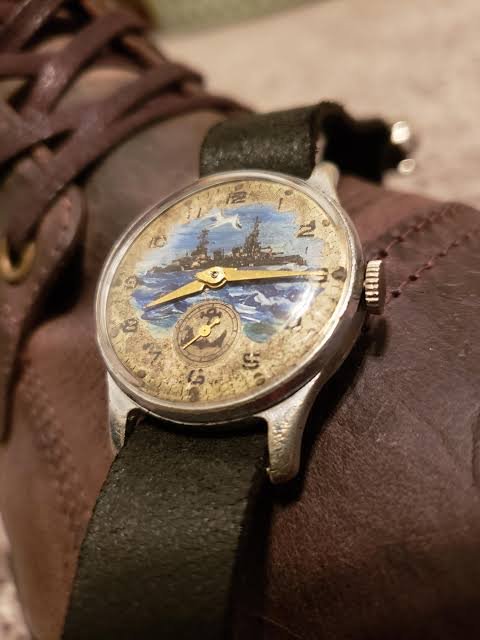
Origins and period
Peterhof—renamed Petrodvorets during the Soviet period—near Saint Petersburg, Russia
Founded as an imperial lapidary factory in 1721; watch production from 1945; active today
Petrodvorets in watchmaking
The Petrodvorets Watch Factory traces its institutional history to the Imperial Peterhof Factory, founded by Peter the Great in 1721 to cut and polish hardstone for palaces, monuments and diplomatic gifts. Its craftsmen developed precision skills in stone and jewel work that later supported industrial production. The site suffered severe destruction during the Second World War and was rebuilt after the Siege of Leningrad. In the mid-1940s it entered watch production, initially making Pobeda watches and components as the Soviet Union expanded domestic horology. In 1961 the factory introduced the Raketa name—Russian for “rocket”—in the era of Yuri Gagarin’s spaceflight. Petrodvorets became a major vertically integrated Soviet manufacturer, producing movements and millions of civilian, military, professional and commemorative watches. After a difficult post-Soviet contraction, the factory and Raketa brand were revived with renewed emphasis on in-house mechanical production and historic Russian designs.
Landmark dates
1721 — Peter the Great establishes the Imperial Peterhof Factory for hardstone cutting and decorative work.
18th–19th centuries — The factory produces architectural stonework, luxury objects and imperial gifts.
1917 — After the Russian Revolution, the former imperial enterprise continues under state control.
1941–1944 — The factory is severely damaged during the Siege of Leningrad and subsequently rebuilt.
1945–1946 — The Petrodvorets plant begins producing watch components and Pobeda wristwatches.
1961 — The Raketa name is introduced in the period of Yuri Gagarin’s first human spaceflight; “raketa” means rocket.
1960s–1980s — Petrodvorets grows into one of the Soviet Union’s major integrated watch factories, supplying civilian and professional watches.
1970 — A special 24-hour Raketa movement is developed for members of the 16th Soviet Antarctic Expedition.
1971 — The factory receives the Order of the Red Banner of Labour.
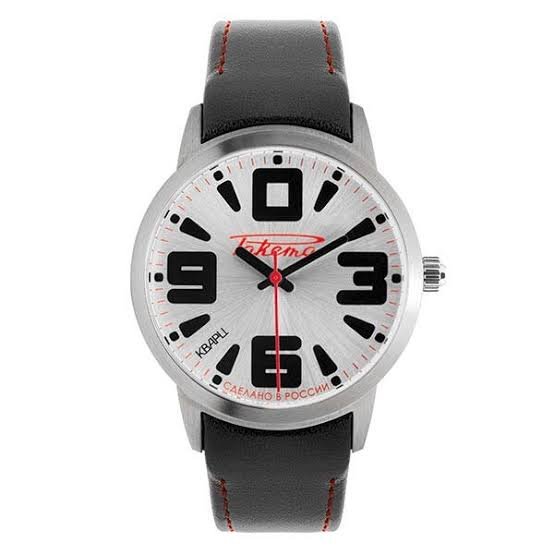
Late 1980s — Distinctive designs such as Big Zero, Copernicus and specialized 24-hour watches become enduring collector favorites.
1990s — The collapse of the Soviet industrial system brings a severe decline in production.
2010s — The factory and Raketa brand undergo modernization while restoring in-house mechanical manufacturing.
Today — Petrodvorets continues producing Raketa mechanical watches near Saint Petersburg.
Known for
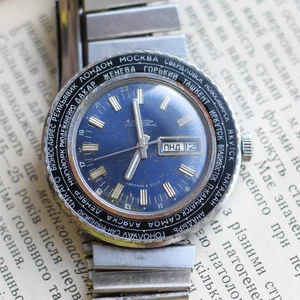
Imperial Peterhof lapidary heritage; Petrodvorets Watch Factory; Pobeda and Raketa watches; Soviet pictorial and commemorative dials; 24-hour Polar watches; world-time and city-ring displays; Big Zero and Copernicus designs; military, naval and exploration themes; Cyrillic day-date displays; manufacture of wheels, escapements and hairsprings.
Movements and innovation
The Petrodvorets factory produced robust manual-wind and automatic movements in numerous Soviet-era variations, including time-only, small-seconds, date, day-date and specialized 24-hour calibres. The 2609 family is widely encountered in conventional three-hand watches, while 2623-series 24-hour movements are associated with Polar and navigation-style models. Later automatic families added central rotors and calendar functions. Modern Raketa production emphasizes renewed vertical integration, including the manufacture of wheels, pinions, escapement parts and hairsprings. Because parts and dial combinations were widely distributed and later assembled, the exact calibre, case reference and production period must be checked together.
Identification checklist
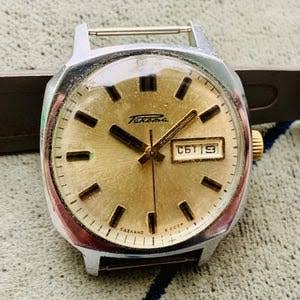
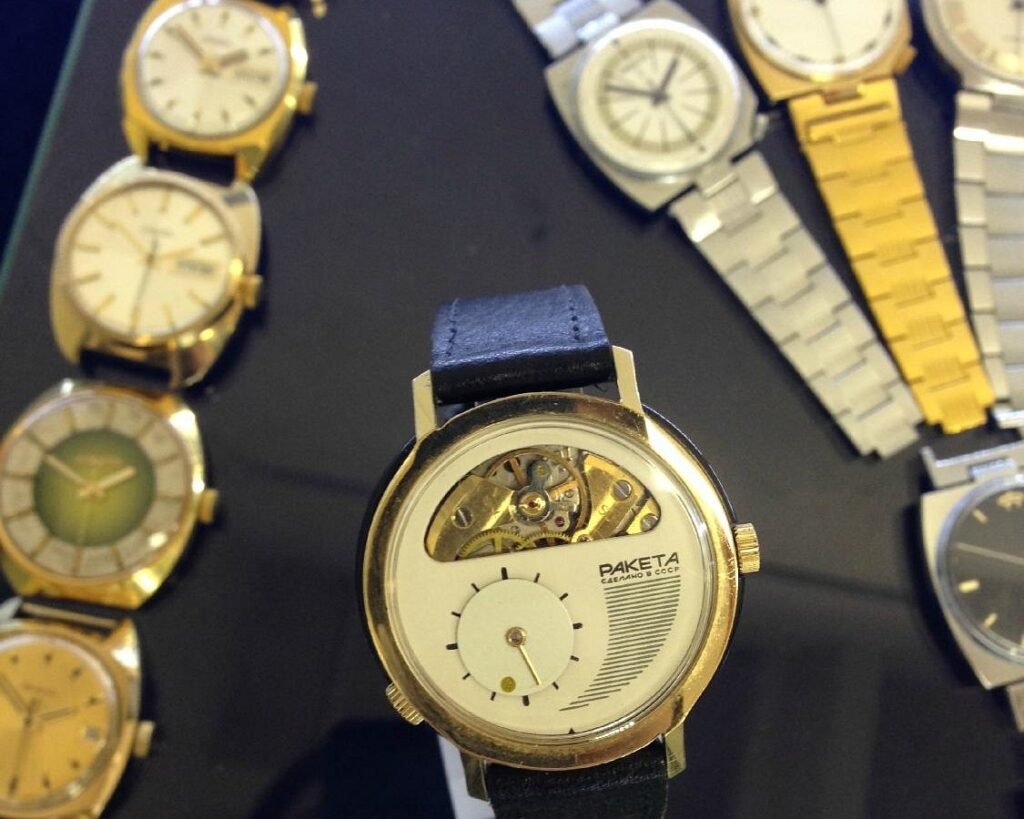
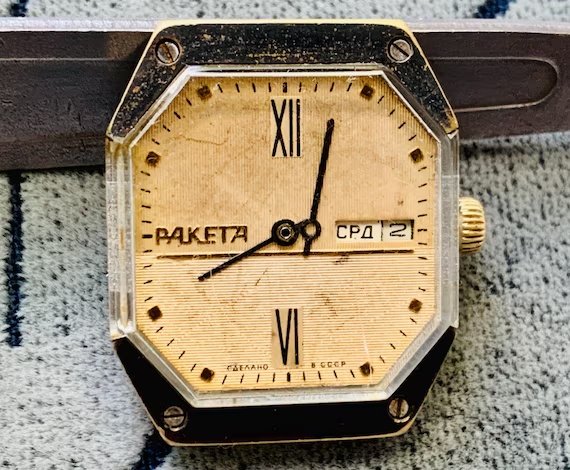
Read the Cyrillic dial and movement markings carefully: “Ракета” identifies Raketa, while “Сделано в СССР” indicates Made in USSR and later pieces may state Made in Russia. Record the calibre stamped beneath the balance or on a bridge, case-back markings, jewel count, date language, hand style and dial printing. Many pictorial, military and commemorative dials were produced or assembled after the Soviet period, and redials are common. Compare unusual dials with period catalogues and inspect whether hands, case, movement and calendar match the claimed era. Exact historical attribution should remain cautious without provenance.
Preservation guidance
Vintage Petrodvorets and Raketa watches should be serviced by a watchmaker familiar with Soviet calibres. Do not force calendar correction near midnight, and avoid repeated winding if resistance becomes excessive. Treat untested cases as non-water-resistant, even when the dial or case suggests military or expedition use. Stabilize flaking or hand-painted dials rather than cleaning them, preserve aged luminous material and original plating, and avoid aggressive polishing. Keep the movement dry and protected from magnetism and shock. Photograph all markings before service and retain original crowns, crystals, hands and replaced movement parts.
Historical development
The Petrodvorets factory began as an imperial stone-cutting works and later became one of Russia’s important watch producers. After World War II it manufactured mechanical movements and watches, eventually creating the Raketa name and a wide range of civilian, industrial, polar, military, and special-purpose timepieces.