Waldenburg manufacture · Founded 1853 · Aviation instruments from 1916
Revue Thommen
Revue Thommen traces its roots to the Société d’Horlogerie à Waldenburg, founded in 1853 to create skilled employment in the Swiss valley. Gédéon Thommen reorganized the business from 1859, and the company became Revue Thommen AG in 1905. It produced watches and movements before expanding into aircraft chronographs and cockpit instruments from 1916. Modern Revue Thommen wristwatches continue to emphasize aviation-inspired design.
Abbady photographic archive
Revue Thommen photographs


Origins and period
Waldenburg, Basel-Landschaft, Switzerland
Founded 1853 · Revue Thommen name from the early 20th century · Continuing heritage
Revue Thommen in watchmaking
Revue Thommen traces its roots to the Société d’Horlogerie à Waldenburg, founded in 1853 to create skilled employment in the Swiss valley. Gédéon Thommen reorganized the business from 1859, and the company became Revue Thommen AG in 1905. It produced watches and movements before expanding into aircraft chronographs and cockpit instruments from 1916. Modern Revue Thommen wristwatches continue to emphasize aviation-inspired design.
Landmark dates
1853 — Société d’Horlogerie à Waldenburg is established
1859 — Gédéon Thommen and Louis Tschopp acquire and reorganize the company
1905 — The enterprise is registered as Revue Thommen AG
1916 — An aircraft chronograph is produced for the Swiss Air Force
1930s–1940s — The company develops cockpit instruments
1945 — A portable altimeter is introduced for mountaineers
1961 — Revue Thommen joins the MSR group with Vulcain, Buser and Phénix
Late 20th century — Aviation-themed wristwatches become prominent
Modern period — Watches continue through Grovana while THOMMEN Aircraft Equipment maintains the instrument tradition
Known for
Waldenburg watchmaking; historical mechanical movements; aircraft chronographs and cockpit instruments; Airspeed pilot watches; pointer-date displays; altimeters; aviation-inspired wristwatches; and the later MSR group.
Movements and innovation
Revue Thommen historically manufactured mechanical calibres as well as complete watches. Later models used movements associated with the MSR group and established Swiss suppliers. Aviation instruments added expertise in chronographs, altimeters, airspeed indicators and aircraft clocks. Airspeed wristwatches often use a central pointer-date hand and highly legible cockpit-inspired dials.
Identification checklist
Record all caseback references, serial numbers and material marks. Photograph the dial, crown, clasp, bracelet and movement. Distinguish Revue, Revue Thommen, GT and MSR-era markings. Confirm whether the calendar is a pointer date or conventional window. Compare movement calibre, hands and scales with reliable catalogues. Do not infer military provenance from dial style alone.
Preservation guidance
Service mechanical watches with unknown history before regular use. Preserve original dials, hands, crowns, bracelets and signed parts, and retain replaced components. Do not assume that an older watch remains water resistant. Avoid aggressive polishing, store the watch dry and keep all boxes, papers, provenance and service records.
Revue Thommen: From Waldenburg Watchmaking to Aviation Instruments
Revue Thommen traces its origins to 1853, when the municipality of Waldenburg in Switzerland’s Basel-Landschaft region helped establish the Société d’Horlogerie à Waldenburg. The enterprise was created to bring industrial employment to the valley at a time when new railway routes were reducing the economic importance of the traditional road through the region.
Over the following decades, the company grew from pocket-watch production into a vertically organized watch manufacturer associated with Gédéon Thommen. Its history later expanded beyond conventional timepieces into aircraft chronographs, cockpit instruments and portable altimeters. The combination of watchmaking and aviation became the defining theme of the Revue Thommen name.
The Waldenburg Foundation
The original watchmaking company began in Waldenburg in 1853. Its purpose was both industrial and social: it aimed to provide skilled work for local residents while developing a sustainable manufacturing activity in the valley. Early production centered on pocket watches and the components needed to build them.
In 1859, entrepreneurs Gédéon Thommen and Louis Tschopp acquired and reorganized the business. Tschopp later withdrew, leaving Thommen as the central figure. The factory became known as Gédéon Thommen’s watch works and expanded its production capabilities. Thommen also played an important role in developing the Waldenburgerbahn railway, connecting the valley’s communities with the wider Swiss transport system.
The Revue Name and Industrial Production
The “Revue” name was used for watches before the company was formally registered as Revue Thommen AG in 1905. By then, the manufacturer had built a substantial reputation for pocket watches, wristwatches and mechanical movements. Watches may therefore appear with different combinations of Revue, Thommen, GT and later Revue Thommen markings.
The factory produced a variety of movements and watches rather than relying on a single famous model. Vintage examples range from simple hand-wound dress watches to calendars, chronographs, alarm watches and specialized timepieces. Movement markings and caseback references are consequently essential for accurate identification.
Entry into Aviation
In 1916, the company produced an aircraft chronograph for the Swiss Air Force. This project established a second area of expertise: precise instruments designed for pilots and aircraft. The requirements of aviation—clear legibility, dependable operation and accurate measurement under demanding conditions—would strongly influence the company’s later identity.
During the following decades, Thommen developed and supplied cockpit equipment including altimeters, airspeed indicators, vertical-speed indicators and aircraft clocks. The aviation-instrument business became technically important in its own right, although the corporate history of the instrument and wristwatch activities later followed different paths.
Military and Civil Instruments
During the 1930s and 1940s, the company manufactured cockpit instruments for military aircraft. Historical watches and instruments from this period require careful documentation because military-style dials and engravings are frequently reproduced or added later.
In 1945, Revue Thommen used its instrument expertise to introduce a portable altimeter for mountaineers. Related instruments were later developed for parachuting and outdoor use. These products helped connect the company’s precision-engineering reputation with civilian exploration and sport.
Movements and the MSR Era
Revue Thommen belonged to the generation of Swiss companies that manufactured mechanical calibres as well as complete watches. Its historical movement families appeared in pocket watches and wristwatches across many decades. Collectors may encounter movements signed Revue, GT, Revue Thommen or with calibre markings connected to later industrial groupings.
In 1961, Revue Thommen became part of Manufactures d’Horlogerie Suisses Réunies, commonly abbreviated MSR, together with brands that included Vulcain, Buser and Phénix. The group sought to combine production resources during a period of increasing competition and industrial change. Shared technology and corporate relationships can complicate the identification of watches from this era, making movement and case evidence especially important.
Aviation-Inspired Wristwatches
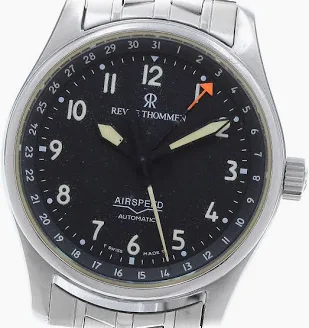
Modern Revue Thommen wristwatches frequently draw on the company’s aviation history. The Airspeed family is the clearest expression of that heritage, using highly legible Arabic numerals, date scales, luminous hands and dial layouts reminiscent of cockpit instruments.
Other collections have included pilot watches, divers, chronographs, regulators, moon-phase watches and classical dress models. Many modern watches use established Swiss automatic or quartz movements, while their cases and dials emphasize the historical identity of the brand.
Reading the Airspeed Dial
Several photographs in the Abbady archive show Airspeed Automatic watches. Their most distinctive feature is an outer pointer-date scale numbered from 1 to 31. A central hand with a colored tip indicates the date, while the main hour and minute hands display the time. This arrangement keeps the calendar visible without using a conventional date window.
Different versions can have black or blue dials, varied bracelets and contrasting pointer colors. Similar appearance does not prove that two watches share the same reference. The exact caseback number and installed movement should be recorded before assigning a catalogue identity.
Later Ownership and Brand Continuity
The Swiss watch industry changed substantially during and after the quartz crisis. Revue Thommen passed through reorganizations and licensing arrangements, while the aviation-instrument operation continued as a specialized enterprise. The wristwatch name remained connected with Waldenburg heritage even as manufacturing and commercial responsibility evolved.
Current Revue Thommen watches are presented through Grovana Watch Co. Ltd., while the aviation company THOMMEN Aircraft Equipment continues to document its own instrument history. Collectors should distinguish the historical factory, the modern wristwatch trademark and the aviation-instrument company rather than treating every period as one unchanged corporate organization.
Historical Timeline
- 1853: The Société d’Horlogerie à Waldenburg is established.
- 1859: Gédéon Thommen and Louis Tschopp acquire and reorganize the company.
- Late 19th century: The factory expands pocket-watch and movement production.
- 1905: The enterprise is registered as Revue Thommen AG.
- 1916: An aircraft chronograph is produced for the Swiss Air Force.
- 1930s–1940s: The company develops and supplies cockpit instruments.
- 1945: A portable altimeter is introduced for mountaineers.
- 1961: Revue Thommen joins the MSR group with Vulcain, Buser and Phénix.
- Late 20th century: Aviation-themed wristwatches become a prominent part of the brand identity.
- Modern period: Revue Thommen watches continue through Grovana, while THOMMEN Aircraft Equipment maintains the aviation-instrument tradition.
Identification Checklist
- Record every caseback reference, serial number and material marking.
- Photograph the dial, crown, clasp, bracelet and movement when accessible.
- Distinguish watches signed Revue, Revue Thommen, GT or related MSR markings.
- Confirm whether an Airspeed calendar uses a pointer date or a conventional window.
- Compare the movement calibre, hand shapes and date scale with reliable catalogues.
- Do not attribute military service from dial style alone.
- Check whether gold-colored components are plated, capped or solid gold.
Preservation and Servicing
Vintage mechanical watches should be inspected and serviced before regular use if their maintenance history is unknown. Preserve original dials, hands, crowns, bracelets and signed components. Replacement parts can reduce historical value, so keep all removed pieces and service documentation.
Aviation-style water-resistance or performance markings should not be assumed valid on an older watch. Seals age, crowns wear and cases may have been opened repeatedly. Have water resistance tested professionally, avoid aggressive polishing and store the watch in a dry, stable environment.
Why Revue Thommen Matters
Revue Thommen represents an unusually broad Swiss industrial story. It began as a regional employment project, became a manufacturer of watches and movements, and developed a parallel expertise in aviation instruments. The company’s watches preserve that history through practical mechanics, pointer calendars and cockpit-inspired design.
For collectors, the name also illustrates the complexity of Swiss corporate history. Different signatures, movement relationships and later licensing arrangements mean that a careful identification must separate visible branding from the exact manufacturer, period and movement inside the case.
References and Further Research
- Grovana / Revue Thommen — Current Collections and Brand Information
- THOMMEN Aircraft Equipment — Aviation History Since 1916
Identification note: Captions describe visible characteristics only. Exact references, movements, materials and production dates require confirmation from caseback markings, movement evidence and reliable catalogues.