Swiss manufacture · Founded 1888 · MST movements and waterproof cases
Roamer
Founded by Fritz Meyer in Solothurn in 1888, Roamer grew from a movement-component workshop into an integrated Swiss manufacture. Its history is closely associated with MST calibres, practical calendar watches and water-resistant Anfibio, Stingray and Rockshell designs.
Abbady photographic archive
Roamer photographs





Origins and period
Solothurn, Switzerland
Founded by Fritz Meyer in 1888
Roamer in watchmaking
Founded by Fritz Meyer in Solothurn in 1888, Roamer grew from a movement-component workshop into an integrated Swiss manufacture. Its history is closely associated with MST calibres, practical calendar watches and water-resistant Anfibio, Stingray and Rockshell designs.
Landmark dates
1888 — Fritz Meyer establishes a watchmaking workshop in Solothurn
1895 — The expanding enterprise develops an early complete calibre
1905 — Meyer and Johann Stüdeli form the partnership associated with MST movements
1920s — Roamer becomes prominent as the principal brand for jewelled lever watches
1952 — The company adopts the name Roamer Watch Co. SA
1955 — Roamer introduces its patented Anfibio watertight case system
1960s–1970s — Stingray, Rockshell and calendar models broaden the sports-watch catalogue
1972 — Roamer enters the quartz era
2003 — Mechanical watches return to the modern catalogue
2013 — A Stingray Chrono Diver marks the company’s 125th anniversary
Known for
Meyer and MST movements, Stingray watches, Anfibio waterproof cases, Rockshell models, and accessible Swiss mechanical watches.
Movements and innovation
Historic Roamer production is closely linked with Meyer & Stüdeli (MST) calibres, including hand-wound, automatic, calendar and alarm movements. Roamer also developed practical water-resistant case systems, most notably Anfibio, and later used outside movement suppliers in some collections. A specific calibre should be assigned only after inspecting the movement stamp and case reference.
Identification checklist
Record all dial wording and logos; photograph the outside and inside of the caseback; note reference numbers, serial numbers, hallmarks and service marks; confirm the movement signature and calibre; compare crown, hands, crystal, bracelet and clasp for period consistency; distinguish original patina from repainting or replacement components.
Preservation guidance
Service an unknown mechanical watch before regular wear. Avoid adjusting mechanical calendars during their changeover period. Do not assume historic water-resistance remains valid; pressure-test before moisture exposure. Preserve signed dials, hands, crowns, bracelets and removed service parts. Avoid aggressive polishing, especially on plated or gold-tone cases, and store the watch dry and away from strong magnetic fields.
From Solothurn workshop to Swiss manufacture
Roamer traces its history to 1888, when Fritz Meyer opened a small workshop in Solothurn, Switzerland, producing cylinder escapements and movement components. The enterprise expanded quickly and began manufacturing complete watches and its own calibres. Meyer later worked with Johann Stüdeli, and the initials MST—Meyer & Stüdeli—became associated with a broad family of in-house movements.
The Roamer name, registered in the early twentieth century, gradually became the company’s principal identity. By the middle of the century the manufacture combined movement production, cases, dials and assembly on an industrial scale. In 1952 the business adopted the name Roamer Watch Co. SA, reflecting the international recognition of the brand.
MST movements and vertical production
Roamer’s historical importance rests partly on its manufacture system. Instead of relying only on outside ébauches, Meyer & Stüdeli developed numerous MST calibres for pocket watches and wristwatches. These included simple hand-wound movements, automatic mechanisms, calendar watches and alarm calibres. The MST signature is therefore a valuable identification clue, but a movement photograph is still required before assigning a specific calibre.
Roamer also used externally supplied movements in some periods and later collections. A Roamer-signed dial by itself does not prove that a watch contains an MST movement. Correct identification should compare the dial, case reference, caseback markings and calibre stamp.
Water-resistant cases: Anfibio, Stingray and Rockshell
During the post-war era Roamer became especially known for practical water-resistant watches. The Anfibio name was connected with the company’s patented watertight case construction in the 1950s. Later Stingray and Rockshell models strengthened Roamer’s reputation for robust sports watches, frequently combining automatic movements, luminous displays, rotating bezels or reinforced case designs.
These historical water-resistance claims must never be treated as proof that a surviving vintage watch is safe in water today. Gaskets harden, crowns wear, crystals loosen and cases may have been opened many times. Any vintage Roamer should be pressure-tested by a qualified watchmaker before exposure to moisture.
Calendar watches, dress designs and modern production
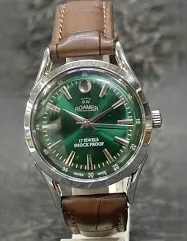
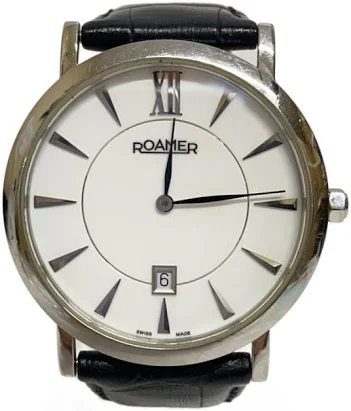
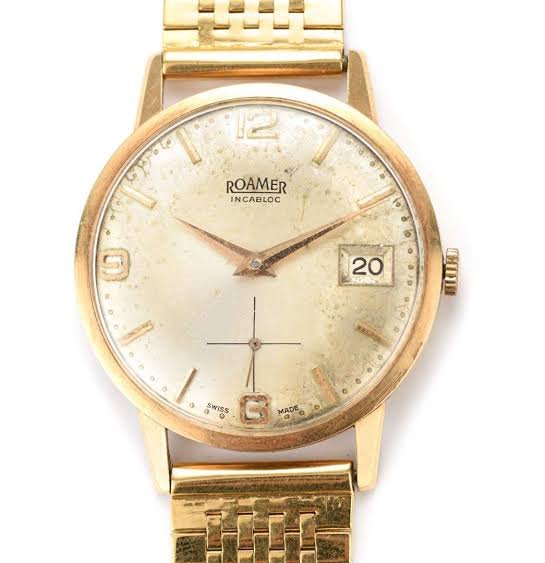
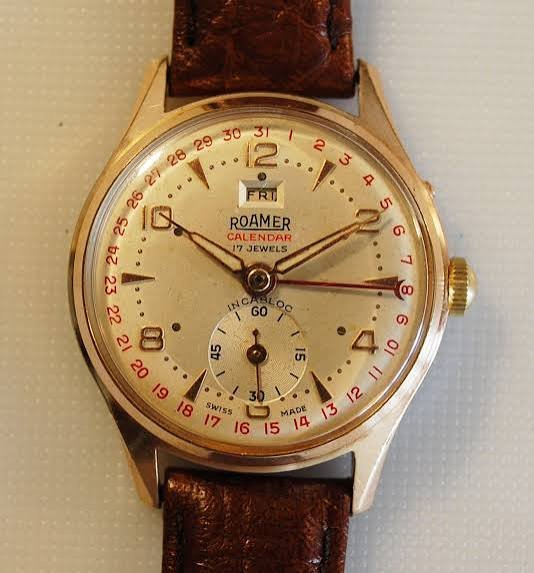
Roamer produced a wide range of watches rather than one single design language. Vintage examples include restrained dress watches, shock-protected hand-wound models, automatic watches, pointer calendars, day-date displays and sports pieces. The photographs in the Abbady archive demonstrate this variety, from mid-century calendar watches to modern Swiss-made automatic and quartz collections.
The quartz crisis transformed the Swiss industry and reduced the role of many integrated manufacturers. Roamer survived through changes of ownership and production strategy, later returning to mechanical collections alongside quartz watches. The modern company continues to use the founding date 1888 as part of its identity.
How to identify a Roamer watch
- Record every word and symbol on the dial, including Roamer, MST, Incabloc, Anfibio, Stingray, Rockshell, calendar terminology and water-resistance statements.
- Photograph the outside and inside of the caseback, noting reference numbers, serial numbers, hallmarks and service marks.
- Confirm the movement signature and calibre beneath the balance or bridges; never assign an MST calibre from the dial alone.
- Compare the crown, hands, dial furniture, crystal, bracelet and clasp for period consistency and Roamer signatures.
- Treat repainted dials, replacement crowns and mixed movement parts carefully, especially when evaluating originality.
Collector and preservation guidance
Vintage Roamer watches should be serviced before regular wear when their maintenance history is unknown. Mechanical calendar mechanisms should not be adjusted near the time when the date is changing. Preserve original dials, hands, crowns, bracelets and signed components whenever possible, and keep any replaced parts with the service record.
Gold-tone cases and plated surfaces should not be aggressively polished because thin original finishes can be lost. Patinated dials should be stabilized rather than refinished unless conservation needs require intervention. Store watches in a dry, stable environment away from magnets, strong sunlight and moisture.
Why Roamer matters
Roamer illustrates the rise of an integrated Swiss manufacturer from a small component workshop to an international watch company. Its MST movements, patented case engineering and broad catalogue provide collectors with a useful view of twentieth-century Swiss industrial watchmaking. The brand’s long production history also rewards careful research: every case, dial and movement must be studied as evidence rather than identified from appearance alone.
References and further research
Roamer of Switzerland — official company history and current collections; Watch-Wiki — Roamer company and calibre overview; Vintage Roamer Watch Site — historical timeline and MST reference material.
Identification note: captions describe visible characteristics only. Exact references, movements, materials and production dates require caseback, movement and catalogue evidence.