Swiss watchmaking with a distinctive British identity since 1895
Rotary
Founded by Moise Dreyfuss in La Chaux-de-Fonds in 1895, Rotary expanded into Britain through a UK office opened by Georges and Sylvain Dreyfuss. Its winged-wheel emblem, British Army supply history and wide range of accessible mechanical and quartz watches made it a familiar British-market brand with Swiss roots.
Abbady photographic archive
Rotary photographs
Origins and period
La Chaux-de-Fonds, Switzerland; established in the British market from 1905
Founded in 1895; active today
Rotary in watchmaking
Founded by Moise Dreyfuss in La Chaux-de-Fonds in 1895, Rotary expanded into Britain through a UK office opened by Georges and Sylvain Dreyfuss. Its winged-wheel emblem, British Army supply history and wide range of accessible mechanical and quartz watches made it a familiar British-market brand with Swiss roots.
Landmark dates
1895 — Moise Dreyfuss begins making watches in La Chaux-de-Fonds
1905 — Georges and Sylvain Dreyfuss open a United Kingdom office
1920 — Rotary introduces the winged-wheel logo
1940s — Rotary becomes an official watch supplier to the British Army
1977 — Rotary sponsors the British BRM Formula One team
2014 — The Dreyfuss Group receives the Queen’s Award for International Trade
2021 — Rotary partners with the Royal British Legion
2022 — Rotary receives Retail Jeweller’s Watch Brand of the Year award
Known for
Winged-wheel emblem; Swiss origins and British-market heritage; British Army supply; dress watches; automatic, quartz, chronograph, skeleton and Seamatic sports collections.
Movements and innovation
Across its history Rotary has used Swiss hand-wound and automatic calibres, later quartz movements, and modern mechanical movements from several suppliers. Collections include calendar, chronograph, GMT, diving and skeleton designs. Calibre, origin and specifications must be verified on each individual watch.
Identification checklist
Inspect the winged-wheel logo and dial signature; record reference and caseback markings; identify the movement and calibre; compare dial typography, hands, crown and date window; check case geometry, plating and bracelet; look for refinished dials or service replacements; verify military claims through caseback markings and provenance.
Preservation guidance
Keep original components and documentation. Avoid aggressive polishing, especially on plated cases. Pressure-test before any water exposure. Service mechanical movements through a qualified watchmaker. Remove depleted quartz batteries promptly. Store dry and away from magnets, chemicals and excessive heat.
Historical development
Rotary traces its origins to 1895, when Moise Dreyfuss began making watches in a small workshop in La Chaux-de-Fonds, Switzerland. The company’s identity soon became closely tied to Britain. In 1905, his sons Georges and Sylvain Dreyfuss established a United Kingdom office to import and distribute the family’s watches. That Swiss origin and long British commercial presence became the defining combination behind the Rotary name.
In 1920 the company introduced its winged-wheel emblem, a compact symbol that remains one of Rotary’s most recognizable identifiers. Rotary expanded through jewelers and became a familiar British-market brand, offering practical wristwatches across a broad range of prices and styles.
Military service and post-war growth
During the 1940s Rotary was appointed as one of the official watch suppliers to the British Army. Military procurement reinforced the brand’s reputation for legibility, dependability and accessible service. Surviving period watches should be assessed carefully, however, because military-style dials alone do not establish issued status; caseback markings, contract details and provenance are essential.
After the war, Rotary produced numerous dress and everyday watches, including hand-wound and automatic models with restrained dials, applied hour markers and date displays. The brand became particularly visible in Britain while retaining its Swiss heritage. In later decades its catalogue expanded to quartz watches, chronographs, sports designs, skeleton watches and modern automatic collections.
Design and model families
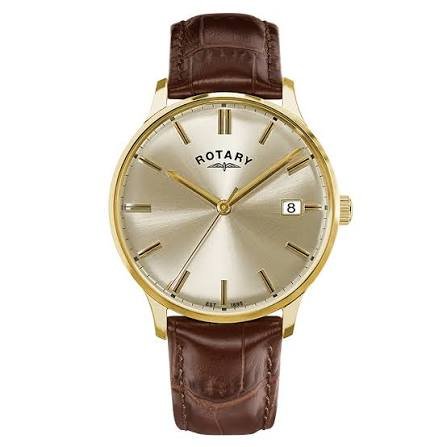
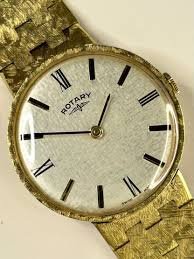
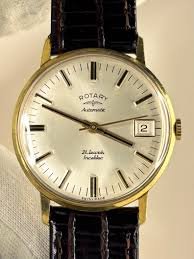
Rotary’s historical output is diverse rather than defined by a single case design. Mid-century examples often use slim round cases, simple baton markers and modest date windows. More recent collections include classical dress watches, open-worked mechanical pieces, chronographs and water-oriented sports watches.
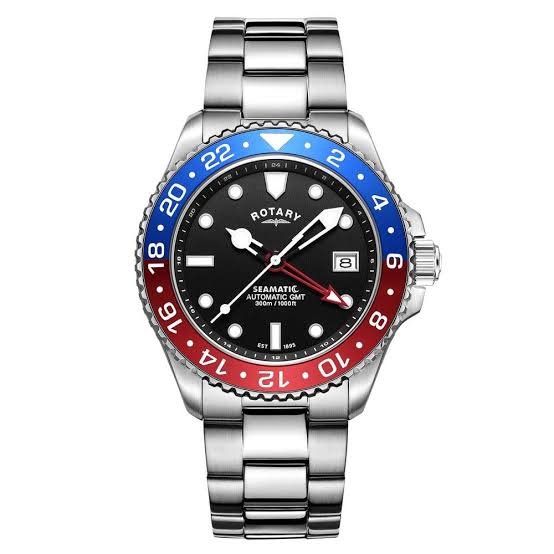
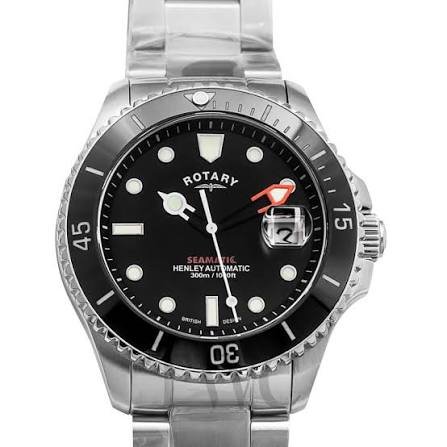
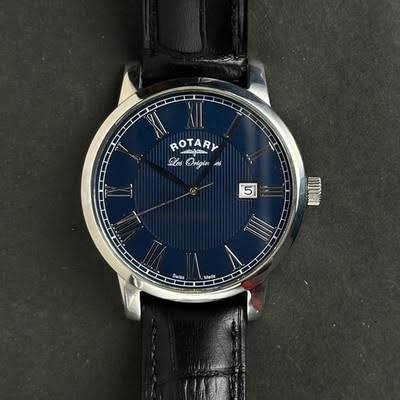
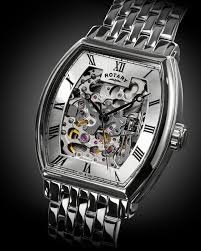
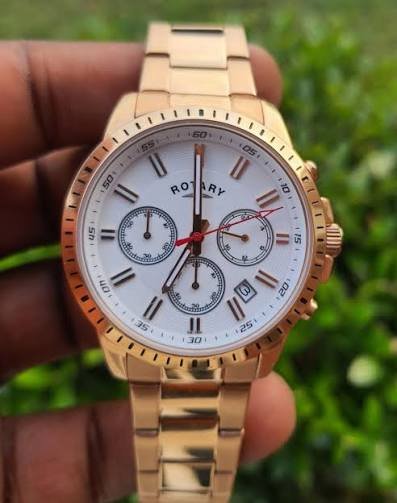
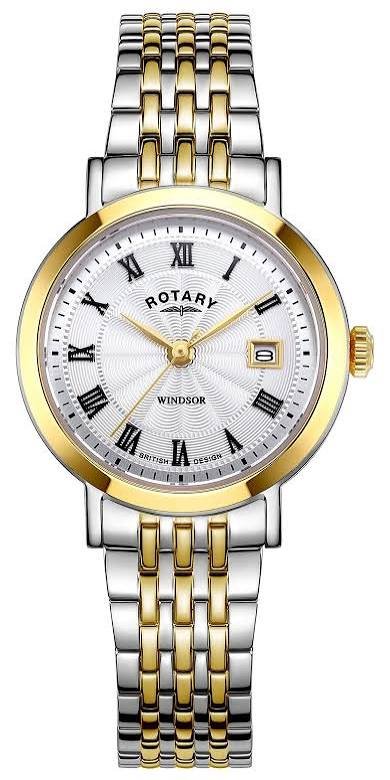
The modern Seamatic family uses strong luminous markers, rotating bezels and substantial water-resistance specifications. GMT versions add a fourth hand and 24-hour bezel for tracking another time zone. Henley watches cover both dress and sports designs, while Windsor models generally emphasize traditional Roman numerals and formal styling. Skeleton models expose part or all of the movement as a visual feature.
Movements and production
Rotary watches have used many movements over more than a century. Vintage pieces may contain Swiss hand-wound or automatic calibres from established ébauche suppliers, while later watches can use quartz or mechanical movements sourced from different manufacturers. The movement type must therefore be verified from the individual watch rather than inferred from the dial logo.
Automatic watches wind through motion of a rotor; hand-wound pieces require regular winding; and quartz watches use a battery and electronic oscillator. Jewel counts printed on some vintage dials describe the movement construction but do not by themselves identify a calibre or guarantee quality. Reference, case and movement markings should be studied together.
Identification and authenticity
Begin with the winged-wheel logo, dial signature, caseback inscriptions, reference numbers and movement markings. Compare the typography, hands, crown, date window, bracelet or strap and overall case geometry with documented examples from the same period. On vintage watches, check whether the dial has been refinished and whether hands, crowns or movements were replaced during service.
Because Rotary offered many regional and retailer-specific variants, a front photograph rarely proves an exact reference or year. Water-resistance wording should never be treated as a present guarantee. A qualified watchmaker should open the case, record the calibre and markings, inspect for corrosion and test the seals before the watch is exposed to moisture.
Preservation
Preserve original dials, hands, cases, crowns, bracelets and documentation whenever practical. Avoid aggressive polishing, which can remove plating or soften case edges. Keep vintage examples dry unless they have recently passed a professional pressure test. Mechanical watches benefit from appropriate periodic servicing, while spent quartz batteries should be removed promptly to prevent leakage. Store every watch away from strong magnetic fields, chemicals, excessive heat and prolonged dampness.
Legacy
Rotary’s importance lies in its durable position between Swiss watchmaking and British consumer culture. From early family workshops and wartime supply to contemporary dress, diving and skeleton watches, the company has maintained a recognizable identity for more than a century while adapting to major changes in movement technology and style.