Independent Swiss family watchmaking since 1919
Titoni
Fritz Schluep founded a Grenchen workshop in 1919 under the Felco name, later Felca. The Titoni name and flower emblem emerged in 1952. The family-owned firm developed Airmaster, Seascoper and Cosmo lines, and introduced its internally developed T10 movement for its 2019 centenary.
Abbady photographic archive
Titoni photographs




Origins and period
Grenchen, Switzerland
Workshop founded 1919; Titoni name introduced 1952; active today
Titoni in watchmaking
Fritz Schluep founded a Grenchen workshop in 1919 under the Felco name, later Felca. The Titoni name and flower emblem emerged in 1952. The family-owned firm developed Airmaster, Seascoper and Cosmo lines, and introduced its internally developed T10 movement for its 2019 centenary.
Landmark dates
1919 — Fritz Schluep establishes a watch workshop in Grenchen under the Felco name
1952 — Titoni name and stylized flower emblem introduced
1969 — Airmaster launched
1979 — Seascoper diver watch introduced
2019 — Centenary and internally developed T10 movement
Known for
Independent Schluep family ownership, Swiss mechanical watches, flower emblem, Airmaster, Seascoper, Cosmo and Cosmo King day-date models.
Movements and innovation
Titoni has long emphasized mechanical and automatic watchmaking. Its 2019 T10 caliber was developed internally and introduced for the Line 1919 collection. Individual pictured watches may use other calibers; movement and reference must be checked case by case.
Identification checklist
Read the full dial wording and flower emblem; record case-back reference and serial details; compare bezel, crown, bracelet, hands and date/day layout with official period references. A model name alone does not date a watch. For vintage examples, a watchmaker can inspect movement and inside case back.
Preservation guidance
Have vintage automatic watches inspected and serviced as needed; avoid forcing a stiff crown or setting mechanism. Keep watches dry unless their present seals have been pressure-tested. Store away from humidity, heat and magnetic fields; preserve original components and documentation.
Historical development
Fritz Schluep founded a small watch workshop in Grenchen, Switzerland, in 1919. The first watches carried the Felco name, later Felca. The Titoni name appeared in 1952, accompanied by a stylized meihua flower emblem. The Schluep family maintained the company’s independence as it developed international markets.
Titoni introduced the Airmaster in 1969 and the Seascoper diver watch in 1979. Its collections also include the Cosmo, Cosmo King and Master Series, spanning traditional day-date watches and sport-oriented designs. In 2019, its centenary year, the company introduced the T10, its first movement developed internally, initially for the Line 1919 collection.
Watches in the photographs
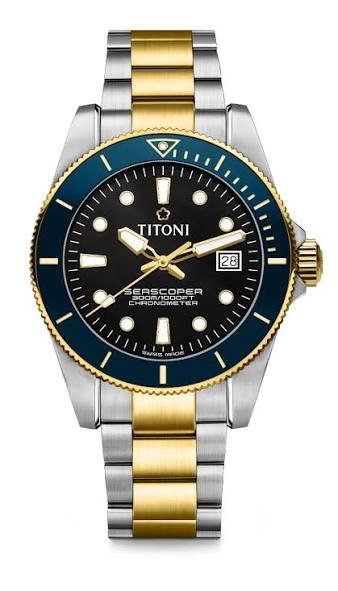
The eight Titoni images show Cosmo King day-date models, a vintage Cosmo 88 automatic, several Seascoper divers and a Cosmo automatic dress watch. One Seascoper photograph appears to repeat the same model in a closer crop. Two other supplied images carry Certina and Mido names and are excluded from this gallery. A photo alone cannot verify a watch’s exact reference, production year, movement, originality or service history.
Identification and care
Compare dial printing, the flower emblem, case-back number, movement and bracelet with period documentation. Have older mechanical watches inspected before regular use. Treat printed depth ratings on vintage cases as historical claims until the seals and case have been tested.